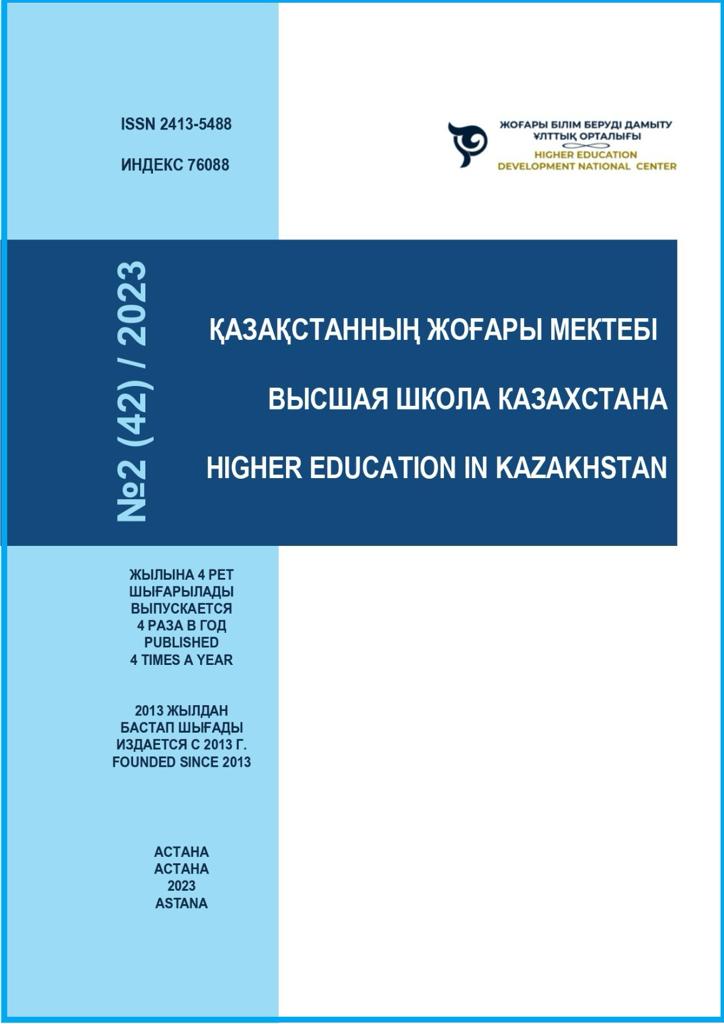
DEVELOPMENT OF MORAL VALUES OF FUTURE TEACHERS IN THE SPACE OF DIGITAL EDUCATION
DOI:
https://doi.org/10.59787/2413-5488-2025-53-1-6-20Keywords:
critical thinking, technology assimilation, formation of moral values and reference points, model of moral judgement developmentAbstract
Over the years, integrating moral values into pedagogical practices through online platforms has received significant attention as the teaching-learning process has been transformed by digital technology. It becomes needful to systematically study how future teachers develop moral values through digital technologies. This systematic review followed PRISMA guidelines by searching research published in Web of Science, ScienceDirect, Scopus and ERIC; these studies were published between 2020 and 2025. In addition, the framework analyzed and synthesized results from 10 research studies on online pedagogical approaches, theoretical frameworks, possible outcomes, and facilitators and problems associated with moral development. The results show that virtual simulations, structured digital discussions, and case-based learning are the key approaches. The predominant theories are Rest’s Four Component Model and Kohlberg's cognitive development theory. Virtue ethics and care ethics receive less attention. Research that measures ethical reflection quality, moral judgments, and professional values most often does not assess long-term retention or the possible outcomes of behavior. Nevertheless, this systematic review shows that digital platforms promote moral education worldwide. These results inform policy-making, educational technology, and teacher education programs.
References
Abdelhafez, A. (2021). Digitizing teacher education and professional development during the COVID-19 pandemic. Academia Letters, Article 295. https://doi.org/10.20935/AL295
Abdullah, T., Alam, A., & Sanauddin, N. (2024). Moral Education in the Digital Age: A Durkheimian Exploration of Values Transmission through Online Learning. International Journal of Distance Education and E-Learning, 10(1), 85-100. http://dx.doi.org/10.2139/ssrn.5313019
Aliyeva, G. B., Honcharuk, V., Pavliuk, N., Zinchenko, V., & Sivachenko, I. (2025). Review of modern pedagogical technologies and methods in the field of philology according to European standards (literature review). Revista on line de Política e Gestão Educacional, Araraquara, 27(2), e023049 https://doi.org/10.22633/rpge.v27iesp.2.18778
Alves, N., Carrazoni, G. S., Soares, C. B., Rosa, A. C. D. S. D., Soares, N. M., & Mello‐Carpes, P. B. (2021). Relating human physiology content to COVID‐19: A strategy to keep students in touch with physiology in times of social distance due to pandemic. Advances in Physiology Education, 45(1), 129–133. https://doi.org/10.1152/advan.00214.2020
Asyaraf, S., & Nazib, F. (2024). Educators strategies in implementing moral educationin the digital era. Advances in Education Journal, 1(1), 35-47. https://journal.al-afif.org/index.php/aej/article/view/5-
Bazán‐Ramírez, A., Alfredo Quispe‐Morales, R., Huauya‐Quispe, P., & Ango‐Aguilar, H. (2020). Accessibility, difficulties and advantages of the online study for COVID‐19 in a presential postgraduate on education. Propósitos y Representaciones, 8, SPE(3), e659. https://doi.org/10.20511/pyr2020.v8nSPE3.659
Bond, M., Buntins, K., Bedenlier, S., Zawacki‐Richter, O., & Kerres, M. (2020). Mapping research in student engagement and educational technology in higher education: A systematic evidence map. International Journal of Educational Technology in Higher Education, 17(1), 1–30. https://doi.org/10.1186/s41239-019-0176-8
Charbaji El-Kassem, R., Lari, N., Al-Thani, M. F., & Al-Khelaifi, B. (2021). A path analytic investigation of teleworking challenges during the COVID-19 pandemic in Qatar. Academia Letters, Article 2616. https://doi.org/10.20935/AL2616
Chávez‐Miyauchi, T.‐E., Benítez‐Rico, A., Alcántara‐Flores, M., Vergara‐Castañeda, A., & Ogando‐Justo, A.‐B. (2021). Personal motivation and learning self‐management in students, as result of the transition to online courses during COVID‐19 pandemic. Nova Scientia, 13(spe), 1–16. https://doi.org/10.21640/ns.v13ie.2739
Copeland, W. E., McGinnis, E. Bai, Y., Adams, Z., Nardone, H., Devadanam, V., Rettew, J., & Hudziak, J. J. (2021). Impact of COVID‐19 pandemic on college student mental health and wellness. Journal of the American Academy of Child & Adolescent Psychiatry, 60(1), 134–141. https://doi.org/10.1016/j.jaac.2020.08.466
Dennis, M., & Harrison, T. (2021). Unique ethical challenges for the 21st century: Online technology and virtue education. Journal of Moral Education, 50(3), 251-266. https://doi.org/10.1080/03057240.2020.1781071
Fuentes, M. C., Bucheli, M. G. V., & Alejo, F. R. (2025). Inductive Methodologies in Education, Supported by the Integration of Technology. The inductive method in the humanities and pedagogy, 38(2025). https://doi.org/10.17163/soph.n38.2025.03
Knopf, T., Stumpp, S., & Michelis, D. (2021). How online collaborative learning leads to improved online learning experience in higher education. In Proceedings of the 8th European Conference on Social Media. https://doi.org/10.34190/ESM.21.010
Kohlberg, L. (1978). Revisions in the theory and practice of moral development. New directions for child and adolescent development, 1978(2), 83-87. https://doi.org/10.1002/cd.23219780207
Koseda, E., Cohen, I. K., McIntosh, B., & Cooper, J. (2024). Internationalisation and digital transformation in HEIs: The impact of education 4.0 on teaching, learning and assessment. Policy Futures in Education, 23(1), 1-9. https://doi.org/10.1177/14782103241226531
Malika, B., Ybyraimzhanov, K., Gaukhar, S., Nurdaulet, S., & Ainur, A. (2022). The Effect of Information Technologies on the Development of Moral Values of Future Teachers Based on Innovations in Education. World Journal on Educational Technology: Current Issues, 14(1), 164-174. https://eric.ed.gov/?id=EJ1334445
Nasimov, M., Maigeldiyeva, Sh., & Paridinova, B. (2019). The concept of spiritual security in science. Perspectives of Science and Education, 40 (4), 10-20. https://doi.org/10.32744/pse.2019.4.1
Novella-García, C., & Cloquell-Lozano, A. (2021). The ethical dimension of digital competence in teacher training. Education and Information Technologies, 26(3), 3529-3541. https://doi.org/10.1007/s10639-021-10436-z
Nurbekova, Zh. K., Baigusheva, B. M., & Baigusheva, K. M. (2023). Digital Didactics: A Textbook: ADAL KITAP, 107. https://ebsadal.kz/book/114/en
Omarov, D., Maigeldiyeva, Sh., Utegenov, Zh., Maigeldiyeva, Zh., & Daribaeva, S. (2016). On the Problem of Formation of the Future Teacher’s Willingness to the Museum Materials. International Electronic Journal of Mathematics Education, 11(6), 1607-1620.
Piragauta, J. A. R., & de Oliveira, J. M. (2023). Do ethics and values play a role in virtual education? A study on the perception of students and teachers. Journal of academic ethics, 21(2), 343-356. https://doi.org/10.1007/s10805-022-09459-z
Turchyn, I., Zaitseva, S., Rudenko, N., Saienko, V., Kuzemko, N., & Denefil, O. (2023). Using Distance Learning Models as Opportunities for Blended Learning for Foreigners. Revista Romaneasca Pentru Educatie Multidimensionala, 15(4), 178-191. https://doi.org/10.18662/rrem/15.4/787
Zhao, Y., Zhao, M., & Shi, F. (2023). Integrating moral education and educational information technology: A strategic approach to enhance rural teacher training in universities. Journal of the Knowledge Economy, 15(3), 15053–15093. https://doi.org/10.1007/s13132-023-01693-z
Downloads
Published
Issue
Section
License
Copyright (c) 2026 Scientific and analytical journal "Higher school of Kazakhstan"

This work is licensed under a Creative Commons Attribution-NonCommercial 4.0 International License.